
Safety Equipment · Ocean Racing Certified
Storm
Jibs
Built to World Sailing Offshore Special Regulations MoMu 0–2 standard. Engineered by ocean racing sailmakers. Sized by the numbers — so you’re never caught out.
Sizing Tool
Storm Jib Calculator
Enter your boat’s foretriangle height (the I measurement from your class certificate or sail plan) and we’ll calculate the maximum OSR-compliant storm jib dimensions and suggest the right size from our range.
Where to find your I measurement:
Your boat's I dimension is the vertical height of the foretriangle — measured from the deck at the base of the forestay to the forestay attachment point on the mast. It's on your class measurement certificate, your sail plan, or your one-design class rules.
World Sailing Offshore Special Regulations
What the Rules Require
All storm jibs for offshore racing must conform to World Sailing OSR. Every sail we make is designed around these rules — which means a Sails.Online storm jib is the correct storm jib, not just a small jib re-labelled.
Area Limit — Rule (a)
Maximum area not greater than 5% of I², where I is the height of the foretriangle.
Luff Length — Rule (b)
Luff length must not exceed 65% of the foretriangle height (the I dimension).
Area Calculation — Rule (c)
Storm jib area is calculated using the official OSR formula, not simply base × height ÷ 2.
Luff Attachment — Rule (d)
Must have a permanently attached, independent method of attaching to the stay — not reliant on any luff groove or furling foil.
No Battens — Rule (e)
Storm jibs shall have no battens. This ensures they can be set and furled quickly in extremis.
Colour — Post-2013 Rule
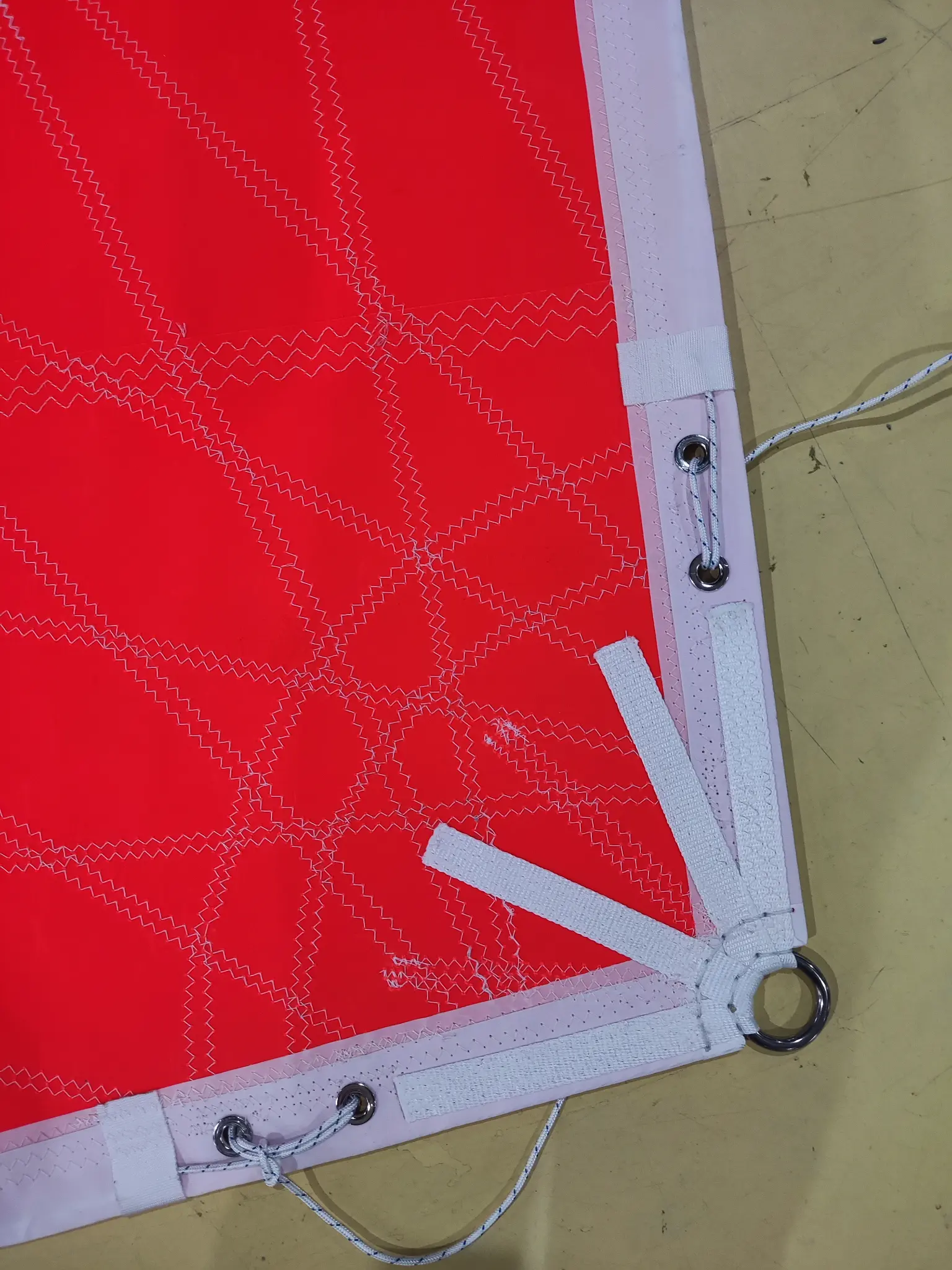
Body material must be a highly visible colour — dayglo orange, pink, or yellow. Visible from the water and from SAR aircraft.
Materials — Permitted & Prohibited
HMPE (Dyneema / Spectra) and similar high-modulus polyethylene fibres are permitted for luff reinforcement and construction. Aromatic polyamides (Kevlar, Twaron), carbon fibre, and similar exotic fibres are not permitted in trysails or storm jibs.
Specifications
Size Chart
All sizes are OSR MoMu 0–2 compliant. All dimensions measured on the finished sail. Use the calculator above to confirm which size is correct for your I dimension. Available in Warp Luff, Hanks, and Luff Tape attachment systems.
| Size / SKU | Luff (m) | Leech (m) | Foot (m) | Area (m²) | Min I (m) | Cloth | Price (AUD) |
|---|---|---|---|---|---|---|---|
| SOL-SJ-XS Extra Small | 3.95 | 3.00 | 2.05 | 3.0 | ≥ 7.75 | 325 g/m² | $203.50 |
| SOL-SJ-S Small | 4.75 | 3.70 | 2.40 | 4.5 | ≥ 9.49 | 325 g/m² | $291.61 |
| SOL-SJ-M Medium | 5.45 | 4.20 | 2.72 | 5.7 | ≥ 10.68 | 415 g/m² | $333.96 |
| SOL-SJ-L Large | 6.10 | 4.82 | 3.05 | 7.5 | ≥ 12.25 | 415 g/m² | $436.42 |
| SOL-SJ-XL Extra Large | 6.90 | 5.50 | 3.45 | 9.5 | ≥ 13.78 | 415 g/m² | $532.57 |
| SOL-SJ-MX Maxi | 7.80 | 6.10 | 3.90 | 12.0 | ≥ 15.49 | 415 g/m² | $652.74 |
All prices AUD inc. GST. Min I is derived from the stricter of OSR limits: area ≤ 5% × I² and luff ≤ 65% × I. All sails include bag, tack pennant, and clew strop. Cross-cut construction. Challenge sailcloth.
We use essential cookies to run the shop, and, with your OK, analytics and advertising cookies (Google, Reddit, Snapchat, TikTok) to see how the site is used and measure our ads. Choose Accept, Reject or set your Preferences. You can change your mind any time.